Monday, March 31, 2014

The gardening season has arrived!

We had a wonderful Seed Fair this past Saturday!

All told, 316 plots checked in, and about 700 people filed into the community center gym including children and grandparents. 

EHCG gardeners selecting seeds at Seed Fair 2014


Committee members Adam and Sandra hosted a gardening workshop, which received many positive reviews. We unprecedentedly sold out of row cover (!!!) and are working on ordering more to sell a new round of the stuff. 

The final orientations were well-attended; my group swelled to about 30 people, all new gardeners at EHCG eager to get into their plots and get seeds into the ground. 

On a personal note, I did get my fava beans, spinach, carrots, peas, radishes, and beets into the ground! I threw down some poppy seeds as well for good measure. I also buried about 50 egg shells and several months worth of coffee grounds into the section of my plot that will soon host tomato plants and basil. Coffee grounds are a wonderful soil amendment! I will discuss this more in a future blog post, later in the season as EHCG begins to truck in its own supply of coffee grounds from local coffee shops.

Looking forward, we will host a cold weather plant sale at EHCG on April 20, a Sunday. Cold weather plant sale items will include broccoli, Brussels sprouts, cabbage, cauliflower, collard greens, kale, and lettuces. Transplants range from $2.50 - $2.75 in various pack sizes, ex 4 broccoli/pack and 6 lettuce/pack. We are also working on getting row cover and compost for the cold weather plant sale, but those items are still TBA. Photos of last year's plant sales are below.


Cold-Weather Plant Sale - April 2013
A wealth of lettuce!
Scott Williams of Garden-to-Be standing proudly behind a wall of lettuces.
 Warm-Weather Plant Sale - May 2013
Army of tomatoes. Scott provides a large array of varieties,
including heirlooms, that varies from year to year.
Brandywine tomatoes. You may want to do some research about
different heirlooms before purchasing transplants, as flavors,
colors, productivity, etc vary widely.

Finally, a forest of basil.

Complete list of plants to be sold at the 2014 plant sales at EHCG:


What will YOU plant this year?

Friday, March 28, 2014

Seed Fair 2014

Hello all -

Seriously, the Seed Fair for EHCG is tomorrow!

All plots assigned for both EH and UH community gardeners will receive 15 tickets (15 tickets per plot, not gardener). You can redeem these for everything from arugula to zucchini, and they are totally free! Residents and students, show up bright and early at the Eagle Heights Community Center at 9 AM - or even earlier if you want a good place in line. All other registered EHCG gardeners enter at 10 AM. At 10:30 AM there will be a workshop covering planting basics. A big thanks in advance to all of our volunteers completing their work day by lending a hand tomorrow morning.

The final orientation tour will also be tomorrow, at noon. Yours truly will be leading one of the tours at Eagle Heights, in addition to one other EH tour guide and parallel tours at UH.

Time to get serious and get planning! If you haven't yet, check out my sample month-to-month plan, and do some investigating into when to put seeds (or plants) in the ground. I recommend using the search bar for the planting guidance page - it's quite long and you may only be interested in a handful of the entries. Although by all means, if you have the time I appreciate you reading it all the way through!

Our garden worker Will has also recommended the site Smartgardener.com, which I am told is slick and has all crazy kinds of features. Check it out!

One final note - we are recruiting a new co-chair to replace Josh Parsons, who after his many years in the gardens has finished his PhD and is moving on to a new job. If you are interested in this volunteer position, please email me (mirrielees@wisc.edu) or the registrar (ehgardens@rso.wisc.edu) so we can discuss more.

I will update this post after the Seed Fair with news and photos.

Happy planning, seed fair-ing, and gardening!

---------------------------------------------------------------------------

Quick edit - photo from last week's orientation at EH:


Will Waller took this picture for us right at the entrance of EHCG.

Thankfully it will be warmer this weekend! I'm sure we're all looking forward to saying good-bye to the ice and hello to sunshine!

(Disclaimer - we have no financial or other affiliation with smartgardener, just an interesting online tool with no commercial endorsement from us.)

Sunday, March 23, 2014

Opening Weekend 2014

Hello all -

Yesterday was Opening Day at EHCG! We had several dozen gardeners come out for the Orientation tours, and with plot assignments up in the gardens and posted online things are really in full swing.

Maybe I should say "full spring" because, compared to this time last year, we are in amazing shape. (You can look back at the March 17 post in this blog for comparison). One year ago, late March in the gardens meant a heavy snow cover and no signs of frost. Walking around the garden yesterday, I spied onion shoots emerging from the soil in many plots, young spinach, and strawberry plants regaining their green color! My tulips are beginning to come up as well. Plots up the hill at EHCG are doing well a little earlier, as they experience an earlier thaw than those of us to the west.

I hope that everyone has had a chance to find their plot at Eagle Heights or University Houses gardens. If you are a first time gardener, please be careful to confirm that you are indeed in the right plot before digging in. A quick check with a garden worker will resolve the situation for those of you who are uncertain.

Our annual Seed Fair will be held next weekend at the Eagle Heights Community Center. All gardeners registered with us will receive 15 (FREE) tickets redeemable for seed packets. We boast an impressive diversity of seeds donated by many local businesses. I advocate for experimenting a little if you have extra tickets - an open mind is how I discovered fava beans at the Seed Fair last year, and now they are probably my favorite thing to grow (and eat!). Expect an email this coming week with more details from the registrar.

I recommend doing yourself a favor and doing some research before picking seeds. Some seeds need to be started inside before being transplanted outside, such as broccoli, cabbages, tomatoes, eggplant, peppers, and basil. While you can certainly choose these kinds of seeds at the Seed Fair, if you don't have the time and resources for germinating seeds inside and growing them for the required span (typically 6 weeks or more), it might be a good idea to spend those tickets on direct-planted crops such as lettuces, beans, all root vegetables, and even squashes. Transplants for these fussy sorts of spring and summer crops can be bought at the cold and warm weather transplant sales we are hosting in April and May (more information in future blog posts). Also, you might want to distribute your seed selections between spring or cool weather crops, and summer or warm weather ones.

It may be helpful for you to consult several resources to plan your garden. The last post I published on this blog went over the planting guidelines for the more common crops grown in our gardens, informed significantly by Robin Mittenthal's From the Ground Up gardening manual, a much more comprehensive resource. Several planting guides for timing exist online, including a spring planting calendar I really like. Individual seed packets will generally also give planting information, although I find some disagreement from brand to brand. I have also posted previously a month-by-month garden plan, which is by no means perfect but a basic framework of how one might plan their planting to fit everything in, at the right time.

This certainly sounds like a lot of planning, and of course feel free to throw caution to the wind and scatter seeds with abandon. I think that most plants can be grown chaotically, and have heard some argument that this may confuse pests who are more attracted to large homogenous plantings, as though they are some miniscale monoculture. I prefer to plan because otherwise I will reach early June without space for melons or ground cherries, and bolted spinach that was planted too late to enjoy.

With that said, happy gardening! See you at the Seed Fair.

Wednesday, March 5, 2014

Planning for the 2014 season: time and space

For many a beginning gardener, there is a significant disconnect between the food he or she wants to grow, and the plant that must be cultivated to grow it. 

Most of us did not grow up on farms, or around agriculture, or even with the luxury of backyard tomato plants. The connection between our produce and the plants that produce them has been severed. Try to conjure the image of an artichoke plant. Can you? What about asparagus? What about broccoli? Zucchini? Struggling with this sort of visualization is very par for the course for first-time gardeners, as most of us have exclusively interacted with trimmed, packaged versions of these crops in the produce section of the grocery store. 

Another challenge is the time required to germinate and raise a plant before its produce can be harvested. While an annual like zucchini takes a mere two months from planting to fruiting, asparagus is a minimum 3 year investment before a single spear can be savored. And when to plant them? Too early, they die of spring frost; too late, the harvest itself is lost to winter.

Planning around the size and time requirements of your crops is a major obstacle between you and a satisfying harvest. Fortunately, many generations of gardeners before you have encountered, tackled, and fine-tuned solutions to the spacial and temporal needs of every food crop under the sun, and resources abound online, in print, and around the garden. This blog post will review common fruit, vegetable, and herb planting guidelines, giving date ranges specific to southern Wisconsin. If you are located outside of this region, you can use other tools to determine good planting dates (here is an example I have used before).

Planning guidance after the jump.


Tuesday, January 21, 2014

2014 season: a prelude

Hello all -

January 21st may seem like a strange day to write a post about gardening in Wisconsin. Here in Madison, several inches of snow obscure the soil, and nightly below-zero temperatures are a weekly occurrence.

However, January is a great month for making plans for the upcoming 2014 season. If you're anything like me, you'll be starting seeds indoors within the next few weeks, are still deciding on heirloom varieties, and are facing an inevitable late-spring dilemma in which you realize that no, you don't have space for both 10 tomato plants AND tomatillos AND a healthy green bean crop.

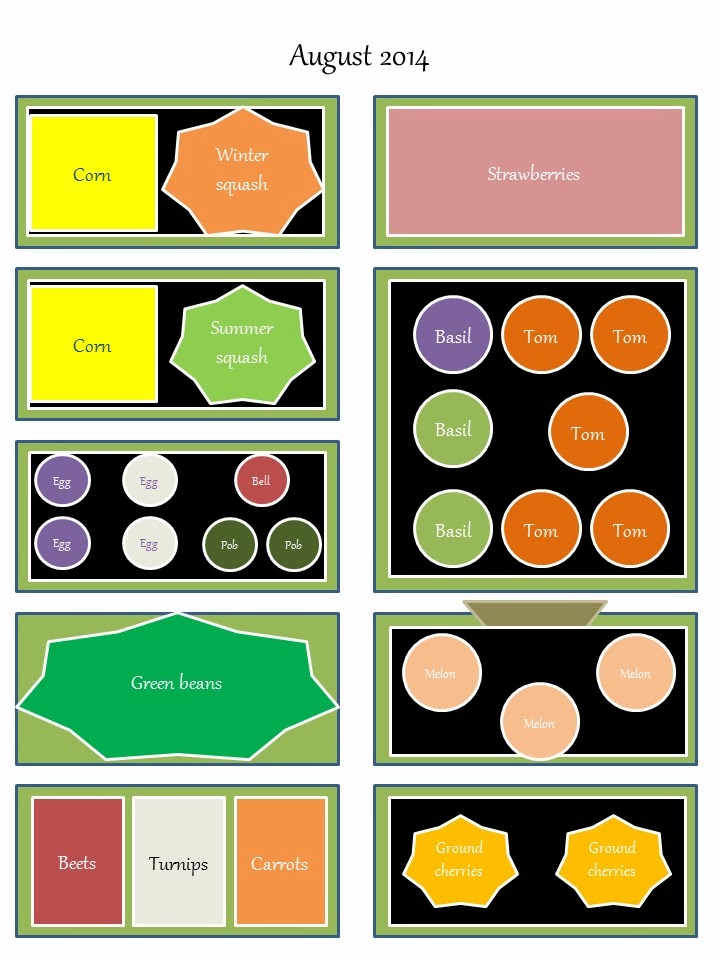
I like to draw out my plot, month by month (or at least season by season), sticking plants here and there until some sort of design emerges. I have done this in years past by hand, but have decided to go with a powerpoint this time. My hope is that the powerpoint format will be easier to edit in the future than the hand drawings, which take hours as I become consumed with the details.

While you may prefer not to put your plans into writing now - or at all - there are a few principles that are helpful to keep in mind while putting seeds and plants in the ground. My next post, the first week of February, will touch on 1) timing, 2) space, and 3) companion planting. For now, I will simply share my plan as an illustration of one way to see a garden space through the growing season.


March
A born risk-taker, I adhere very literally to the phrase "as soon as the soil can be worked." Depending on the snow and state of the soil, this can be as early as mid-March. (Last year, we still had snow in the ground in late April, so sometimes plans have to adapt to Mother Nature.)
Ideally, I will be planting spinach, peas, fava beans, and root vegetables by the end of March. These crops are frost-tolerant, so I am not worried about losing them. I have had a lot of advice in the past about waiting longer, but have never lost a spring crop to frost, and will continue to take the risk. If you are risk-averse and/or can't stand the thought of resowing these seeds, it may be in your best interest to wait until early or mid-April.
If you choose to plant peas, remember to provide a support of some kind (the upside-down brown triangle represents the trellis in my plot).


April
Aside from sowing second crops of the early spring vegetables, I spend April patiently awaiting the bounty planted in March. I also put down black plastic over the soil where I plan to plant heat-loving crops, such as tomatoes, eggplants, and peppers. While not universally popular, I find that the black plastic method does speed up the growth and fruit production of these plants, as well as keeping weeds from popping up.
Speaking of weeds, April is a prime month for weeding. While the soil is still too cold for most of your food crops, several weeds find this month a perfect time to germinate and slowly conquer your plot. I will post sometime in the next few months a guide to weeding. Just remember to be vigilant.


May
By May, it's safe to say that the growing season is well underway!
Whether your buy your summer transplants at the Eagle Heights Community Garden warm-weather plant sale, at the farmer's market, at Home Depot, or even start them yourself at home, now is the time to get them into the ground.
Crops to transplant in May include: squash (summer, such as zucchini, and winter, such as butternut), tomatoes, ground cherries, tomatillos, warm weather herbs such as basil and melons.
Crops to sow directly include: green beans and corn.
Note that I have planted/transplanted some of these crops through the black plastic to speed up growth and fruiting.


June
I prefer to wait until June to put fussy, heat-loving crops like eggplants, peppers, and melons outside. This decision is partly because I plan to keep harvesting my peas, carrots, and radishes into mid-June, and am willing to wait until I have harvested the last good sugar snap pea pod to put my melons in the ground. Having a limited gardening space means that you sometimes have to stagger crops, intentionally putting off a summer crop to allow a spring crop to run its course.


July
July is mostly a month for harvesting. It's too late to put most summer crops in the ground, and too early for the fall crops. The fava beans, and any remaining spring crops, will shrivel up by July, and can soon be replaced.


August
Once the fava beans have run their course, an early crop of fall root vegetables can be planted. Most of the summer crops are still going strong.


September
By September, several summer crops have stopped producing, and can be replaced by more fall crops. I like to plant large amounts of spinach, as it can be frozen easily. In places you don't plan to plant fall crops, a heavy pile of leaves make a nice mulch to prevent weed growth.

Come October, a hard frost will inevitably kill almost everything in your plot. A final harvest of tomatoes, peppers, eggplants is accompanied by the harvest of winter squashes, a harvest long in the making. My spinach frequently grows through lights frosts, but with few exceptions I am done gardening for the year.

---------------------------------------------------------

What do you plan to plant this coming year?

Saturday, August 3, 2013

A summer harvest

Despite below-average summer temperatures and perhaps a little too much rain, the Eagle Heights Community Gardens has been showing off abundant produce for the last few weeks.

The average first-time gardener has many worries: "what do I plant? When and where do I plant it? Do I water it?  Fertilizer?  What am I doing at all?"  Although simply keeping your plants alive through a single season may seem a daunting challenge if you are a beginner, by this time in the year you have probably discovered any entirely new and foreign worry.

"How do I eat all of this?"

Never thought you'd outpace your own appetite in the garden?  You're not alone.  One inescapable law of growing food is this: you either grow way too much or way too little.  Chief offenders in the "too much" category include zucchini and other summer squash, cherry tomatoes, beans, spinach, raspberries...the list goes on.  If you weren't prepared to be inundated with pounds of produce by late July or early August, you may at a loss for what to do with all that food.

There are many ways to face the challenge of using up one's garden bounty.
  1. Eat as much of your fresh harvest as possible.  In the summer months, make self-sustainability a priority, and think ahead to plan your meals around what is available to harvest.  Craving salsa and chips?  Skip the jarred stuff at the store and take a quick trip to your plot to harvest just-ripened tomatoes.  Italian sounds great?  Turn your ripe eggplants, zucchini, tomatoes, and basil into a garden-fresh lasagne.  Focusing your meals on what you have ready to pick will prevent fruits and vegetables going to waste in your plot, and will be easier on your wallet.
  2. Save some for the winter.  Most vegetables can be frozen after being blanched, or briefly boiled (obvious exceptions include lettuce and cilantro).  Canning has also become quite popular.  I'm no expert with either of these, and am trying both for the first time this year.  Thankfully lots of information is available online with a quick google search (ex. http://nchfp.uga.edu/).
  3. Share with friends!  You can generally find some friend, family member, or even acquaintance interested in unloading fresh produce off of you for free.  
  4. Share the Bounty.  At EHCG, we have a program with St. Vincent de Paul that allows our gardeners to donate produce to those in need via distribution through the food pantry.  Fruits and vegetables are collected on Saturday and Wednesday mornings.
  5. Let your crops rot in your plot.  Just kidding!  Don't do this.
I've chosen to write about this tonight because I, too, still run in to this pervasive gardening dilemma.  Walking home from the gardens today, I was carrying four zucchini, two pounds of cherry tomatoes, four eggplant...well, instead of listing it I'll just show you what kind of harvest I walked away with today.
Cherry tomatoes (Mexico Midget and Sungold), raspberries, zucchini (Ronde de Nice), pattypan squash (Patisson Panache jaune et verte, although all I see is jaune), eggplant (Udumalapet), green beans (french climbing) , fava beans, bell pepper, one single tomato (Federle), tomatillos (Green Husk), and finally a bag of ground cherries (Loewen).  That's a lot of veg!
 Once I had sized up my haul, it was time to get down to business.

I am often tempted to scout out entirely new recipes as the seasons change, which is good fun, but I do have a few go-to options for days like today when I have a large haul of in-season goodness.  If you find yourself loaded down with your summer harvest as well, feel free to try the following to make fast, sensible, enjoyable use of your bounty.

Confronted with a large quantity of diverse vegetables, I roast first and ask questions later.  (Seriously, there will always be more cherry tomatoes,eggplant, and zucchini left for snacking and other meals: may as well get this high-volume meal out of the way first.)

Tossed with a bit of oil and topped off with sea salt, my garden veggies have roasted at 350 F for about 20 minutes.  


I simply eat the roasted vegetables over fresh pasta with some Parmesan and fava beans.  The fava beans weren't roasted, but blanched and shelled.  I know that you can only see a glimpse of pasta in this photo, but that is the point: in the summer, maximize your veggie consumption even if it means less of everything else.  There will be plenty of carbs to eat this winter, won't there?

Not so tough, right!

Of course, after this massive veggie feast, I've really barely put a dent in this week's harvest.  I need to do some more brainstorming and planning to make sure all of this gets used up in the coming week!  

I'm sure it seems a little nuts to some people to really put time and energy in to planning meals around the seasons and the harvest.  Why stress out about gathering and cooking what's in my plot when there is a fast food joint right here?  Well, it's my opinion that taking a little time out of the day to harvest and prepare my own crops is worth extremely fresh, extremely local food, even if it's outside of the on-demand, high-stress mainstream perception of food, eating, and life in general.  I'm also certain that my great-great-grandmother didn't eat the kinds of things you can buy quickly and cheaply today: red meat on snow-white bread, beef in the spring, tomatoes in the winter, everything year-round and shelf-stable.  Although I know that my ancestors ate in-season because they had no alternative, I like the idea that what I am giving my body is not so divorced from what they gave theirs.

Plus it's fun!  When you think of tomatoes as unique to mid-to-late summer, they become a real treat.  Fall leeks lend something really special to soups.  And kale harvested in the dead of winter, from beneath a cold frame!  The link between the seasons and our foods is really quite magical, and tells a beautiful narrative of death and rebirth, sowing and reaping, all year round.

On a final note: ground cherries!
The empty husks do indeed indicate that I ate a few on the walk home.

My friends Uyen and Phia, fellow gardeners, helped me to harvest these ground cherries earlier today.  These fruits are extremely prolific and make a great snack for a short break from weeding.  It's too late to start these little guys this year, but I would encourage anyone to try growing these sooner or later.  Aside from being sweet, these fruits are actually fun!  They are called ground cherries because you only harvest them when they have fallen on the ground...so harvest includes a lot of bending over, searching through branches, false leads, and sudden successes.  We agreed that it was a sort of late summer Easter egg hunt for adults.

One (other) final note: fall crops!  I have noticed that few people tend to agree on exactly what to plant when; however, here is a link to the Seed Savers Exchange guidelines for putting in cool weather plants in the fall.  I must admit that I have already planted all of these myself, as I prefer to err on the side of too early.  With the recent cool weather, I really do feel that Autumn is just around the corner.  With a little planning, you can (almost) guarantee a satisfying fall harvest of root vegetables for stews if nothing else!

That's it for tonight.  Happy gardening.

Sunday, July 21, 2013

Weekend update: photos of progress in the garden at midsummer


Hello all--

Below is a photographic update of what I am doing in the garden at this point in the summer.  By now most of the planting is done, save that of the fall crops.  Many of us are already harvesting early or even midsummer produce, the stuff of an organic gardener's dreams throughout a snowy February.

I did a bit of "work" in the garden this Saturday, mostly poking around my plants.  I like to check up on each plant at least once a week, doing a relatively thorough assessment.  It's important to watch one's crops for disease, water distress, breakage, pests, theft, and, worst of all, unpicked produce.  By mid-July, many plants are on the cusp of producing edible fruit, so I pay extra attention to those on the verge.  If I'm not careful, I'll be absolutely drowned in overripe tomatillos around the first week of August.

Checking on the tomatillos.  As you can see above, tomatillos have a tomato-like growth habit, and have quickly outgrown their cages.  Unlike tomatoes, tomatillos grow in a papery husk, and don't deepen from red to green.  They are ripe when the fruit begins to outgrow the husk, and can be used for many permutations of salsa verde.  On a side note, these plants are far more prolific than I had anticipated.  Let me know in the comments if you are interested in learning more about tomatillos.


Every day I come to work in the garden, I am greeted by a mass of cheery blue Bachelor's Button.  I decided to start growing these when I found out they were a classic garden flower, and am happy with taking the chance.  They have grown rather tall, and the wood trellis behind them has been helpful for support.

 I would like to encourage new gardeners to grow an annual ornamental, such as a flower, in some unplanted space in the plot.  Flowers are attractive, not only to people but to pollinating insects as well.  Tall flowers like Bachelor's Button can also act as a border; mine mark the entrance to my plot.  I would also rather use extra space in the garden for an attractive annual than risk letting it go to weeds.

At home, I am also growing Johnny Jump-Ups (not shown here), a variety of viola that is another classic garden flower.


Onto the harvest!

As I mentioned, I am bracing myself for a deluge of tomatillos in the coming weeks; however, many fruits and vegetables are already ripe for the picking.  I have so far harvested zucchini, cherry tomatoes, basil, eggplant, and fava beans for roasted summer vegetables with pasta.
Ripe Mexico Midget cherry tomatoes contrast nicely with the plant's foliage.  If you happen to pick a bunch of cherry tomatoes only to find that a few are still green-to-yellow, you will find that these underripe casualties are still fine for roasting along with their redder vinemates.
Bell peppers.

I am already getting full-sized bell peppers, the
earliest I have ever had them come in.  I am doing
something special for them this year (see below).


Udumalapet eggplant.
This variety is vertically striped yellow and purple.
This is my first year growing them and I am
excited to see if they taste as nice as they look.
One reason for my early success with tomatoes, eggplant, and peppers this year is my use of black landscape plastic.  When I decided to grow eggplant and peppers, two notoriously tricky crops in Zone 4 and above, I did some research online and in the gardening manual available at the official EHCG website.  I found that many gardeners in zones with short summers use black plastic to warm the soil before planting these fussy plants.  After putting the starts in the ground, I left the black plastic over the soil to keep the roots warm.  Although I will admit that this strategy sounds a little strange, I was able to successfully move my transplants into the garden earlier with this technique, and the produce I have already harvested is proof enough for me.  As an added bonus, the black plastic allows absolutely no weed growth around my precious tomatoes, eggplant, and peppers.  The only issue I've found is that I have to be very careful with watering.  It is a little tricky to water only the base of the plant while avoiding splashing it all over the plastic, which would be a waste.    

Other gems of the summer bounty are getting ready to make their debuts.  My green beans are several feet tall.  I am growing these just a foot away from my broomcorn and winter squash, hoping for some approximation of a "three sisters" effect.

French climbing bean, almost ready to flower.
Waltham butternut squash and spaghetti squash.  
I planted these two close enough that the long vines 
are now too interwoven to easily tell them apart.  
The fruits, however, have very distinct shapes.  
The small butternut (left) is beginning to take on 
a pear shape, while the spaghetti (right) is straighter.


You may be wondering, where is the corn?  "Three sisters" describes a strategy whereby beans, squash, and corn are planted together to take advantage of specific strengths of each crop, and in turn providing defense or support to the other "sisters" in the planting.  My climbing beans are natural nitrogen-fixers; nitrogen is required for plant growth, one of the hallowed N-P-K macronutrients (nitrogen, phosphorus, and potassium in order).  Squashes are heavy feeders, thriving on the nitrogen-enriched soil.  As you can see in the photo of my squash, these crops cover exposed ground (and anything else) really well, and can be used to prevent weed growth around sensitive crops.

Broomcorn.  I planted the "Mixed Broomcorn" available from Seed Saver's Exchange, which will (hopefully) encompass several colors of sorghum for a smashing fall display.  Note the winter squash vines around the base of the corn, as this is my weed management strategy for this part of my plot.  
Typically, the beans would grow up the corn instead of the netting in the above picture.  However, I have split my sisters up a bit, and am growing broomcorn separately.  If you are not familiar with broomcorn, it is actually a member of the grass family (sorghum).  Broomcorn is so-named because the fully-matured sorghum can be tied together, dried out, and used as a broom.  Brooms in the United States were made this way from the 19th century onward, replaced in our lifetimes by more modern, synthetic materials.  I'm not sure how well I could fashion a broom myself from broomcorn, and am planning to use this as a fall display.

While I'm on the subject of corn, please take a moment to enjoy this row of corn exhibited (with permission) by a fellow EHCG gardener.  In addition to the photo, this gardener shared with me a RAW ear of bicolor sweet corn, picked right from the plant, that was one of the most amazing things I've ever tasted.  I am growing sweet corn at home myself, and hope to repeat the experience soon.


Sweet corn.
I will also share this snapshot of yet another gardener in her plot at EHCG, watering the cucumbers on a hot day.  Looking after everything in the garden from week to week, from the lows of April to the highs of July, can be taxing, and it's nice to see fellow gardeners putting time and energy into their plots rain or shine.

 I have one more curiosity to share with you: ground cherries.  These plants are akin to low-growing tomatillos, but the fruit that emerges from the husk is sweet and yellow, not green.  Given the culture conditions for ground cherries, they are easier to grown and higher-yielding than many other dessert fruits produced by small gardens.  If you haven't tried ground cherries, consider picking up a bag at the farmer's market some time this summer.  If you fall in love, you can easily grow them next year.

Ground cherries.  I am growing the Loewen family heirloom ground cherry available from Seed Savers Exchange.  I am not sure how this compares to other ground cherries, and will keep an eye out for them at the farmer's market to do a side-by-side taste test.  Note: these fruits are ripe when the husk falls from the plant.
In three months, this will become palak paneer.
One final note: it's time to get serious about fall crops!  While the recent heat wave may suggest otherwise, fall is coming whether we like it or not. Every year I wait until it "feels like fall" and get burned.  This year, I am starting my fall crops earlier than all of my neighbors, and will see just how early these can be put in the ground successfully.  To the right is a row of spinach sprouts, emerging from the dry ground despite the recent hot weather.  Carrot and beet sprouts have emerged as well, along with broccoli.  Whether you start your fall crops on the early side or the late, it's a good idea to at least have a plan this late in the year, or your 2013 gardening season will abruptly end by the time you are pulling out dead annuals after the first frost.

That's about all I have to say about gardening at EHCG today.  Wear sunscreen and keep your skin protected!  Harvest your produce frequently!